
Why monitored duress alarms matter for disability support workers
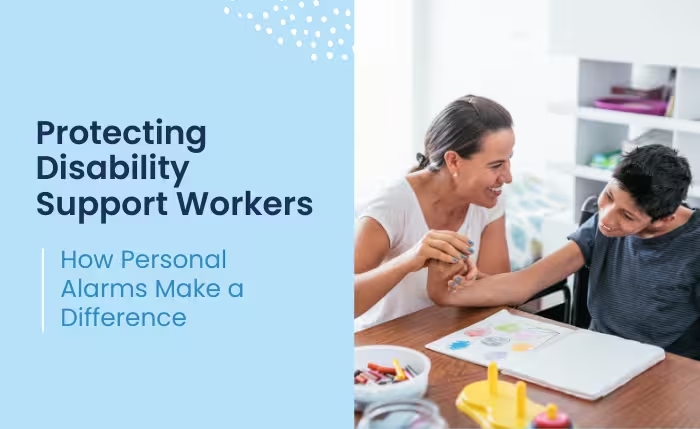
Supporting disability support workers with safer, more reliable response
Disability support workers play a vital role in the community, often supporting people in settings that are dynamic, unpredictable and, at times, high risk. Their work can involve personal care, medication support, behavioural escalations and emergency situations — often without direct supervision or immediate backup.
Many support workers operate as lone or isolated workers, particularly during overnight shifts or in community-based settings. This adds an extra layer of risk. Without someone nearby to assist, incidents such as falls, aggression, medical emergencies or environmental hazards can escalate more quickly and limit access to fast help.
Under Australia’s Work Health and Safety (WHS) legislation, employers have a clear duty of care to manage these risks and ensure workers can access help quickly if something goes wrong.
Why duress alarms are critical for lone worker safety
A duress alarm is a simple, wearable safety device that allows workers to call for help instantly in an emergency, usually with the press of a single button. In high-pressure situations, the worker may not be able to use their phone to dial for help, or navigate to an app to raise an alert. They may also not be able to speak clearly or leave the environment. That's why immediate, discreet access to assistance is so critical.
What are the benefits of monitored response
Not all duress alarms provide the same level of support. Monitored systems connect workers directly to a dedicated emergency response team, rather than relying on colleagues or preset phone numbers. This distinction matters in real-world scenarios.
A monitored duress alarm device provides:
- 24/7 Real-time response by trained operators
- GPS emergency tracking to pinpoint the worker's location
- Two-way audio through the alarm
- Call recordings
- Help is provide even if the worker cannot communicate
These features are designed to reduce response times and ensure support is available when it is needed most. With a professional team always available to assess the situation and escalate as needed, support continues until the situation is properly resolved.
This is especially important in disability support environments, where situations may involve complex care needs or require rapid coordination.
Learn more about the MePACS Duress Alarm →
Building safer workplaces and meeting duty of care
For organisations delivering Supported Independent Living (SIL) and Specialist Disability Accommodation (SDA), protecting staff is both a legal responsibility and a practical priority.
Workplace safety frameworks in Australia require employers to:
- Identify and assess risks associated with lone or isolated work
- Provide reliable communication systems
- Ensure emergency procedures are in place
Duress alarms are one of the most effective ways to support these requirements. They provide a direct communication pathway in emergencies, helping reduce risk and ensure timely intervention. Importantly, safer staff leads to better outcomes for participants. When workers feel confident and supported, they are better able to focus on delivering safe, high-quality care.
Supporting confidence, continuity and care
For disability support workers, personal safety is not separate from the quality of care they provide — it underpins it. A reliable duress alarm acts as a constant safety net, giving workers confidence that help is always within reach. It reduces the pressure of working alone, supports better decision-making in critical moments, and helps maintain continuity of care for participants.
For providers, it is a practical step toward creating a safer, more resilient workforce.

|
Protect your staff today!Ready to take the next step in supporting your team? Send an online enquiry or contact us on 1800 685 329. Online Duress Enquiry → |
.avif)

.avif)
%20(1).avif)